

DIS 2026 Workshop: Moving and Crafting Data Together
Critical and Feminist Perspective on Technologies for Movement through Movement
June 2026 | Singapore
Description
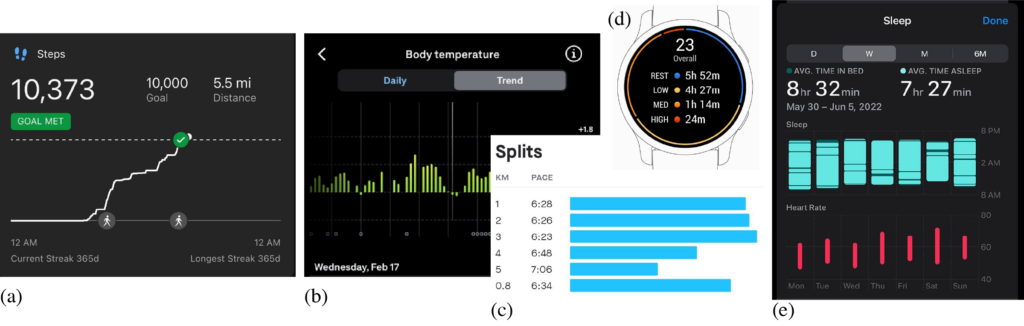
In this workshop, we aim to bring together members of the DIS community who practice any form of physical activity and engage in self-tracking or data representation to explore their experiences (re)configuring, appropriating, and engaging with the materiality of their data. We will collectively interrogate how people live with, negotiate, represent, and reappropriate data in relation to their embodied, social, and moral worlds. Thus, moving beyond understanding “successful” engagement with movement technologies and data as compliance, optimisation, or behavior change, and towards ongoing negotiation, care, labor, and adaptation.
Our workshop would be of interest to designers, researchers, and practitioners working on topics related to (1) soma design, movement, physical activity, and sports, (2) personal informatics, (3) data interpretation, visualization, and physicalization, (4) critical and feminist perspectives on data, and (5) body-based interaction. Through our workshop, we expect to contribute towards the design of movement technologies and data that are interactional, experiential, material, and relational.
Workshop Schedule
Morning Session: Moving and Gathering Data (9:30-12:30)
09:30-09:45 – Welcome and Goals: Arrival and introduction to the workshop’s objectives and schedule.
09:45-10:15 – Participant Introduction: We will ask each participant to introduce themselves and share their motivations for attending the workshop.
10:15-10:45 – Moving Together: One of the organisers will lead a guided warm-up activity of varying intensity to help set the tone of the workshop and invite participants to turn their attention to their own bodies.
10:45-11:45 – Moving with Data: Organisers and participants will engage in a 60-minute movement session or activity of their choice (e.g., stretching, walking, running) and collect data about it as they normally would.
11:45-12:30 – Collective Discussion: We will gather participants and discuss the different activities we performed, as well as the data we collected and chose not to collect.
—
Lunch Break (12:30-13:30)
—
Afternoon Session: Crafting Representations and Discussion (13:30-17:00)
13:30-15:00 – Crafting Data Representations: We will invite attendees to creatively represent the data gathered during the movement session, by creating personal or collective representations.
15:30-16:30 – Showcase, Discussion, and Design Critique: We will gather participants and invite them to present their creations and discuss key insights.
16:30-17:00 – Reflection and Next Steps: Identifying opportunities for further engagement and collaboration
Organisers

Alejandra Gómez Ortega (she/her) is a Digital Futures Postdoctoral Fellow at Stockholm University, Sweden. Her research applies critical and feminist perspectives to investigate how we interact with and encounter our data and their algorithmic derivatives through design. Alejandra has experience co-organizing creative sessions and workshops on sensitive and intimate topics around data.

Alice Haynes (she/her) is a Digital Futures Postdoctoral Fellow at KTH Royal Institute of Technology, Sweden. Her work centers on designing body-centered haptic and shape-changing interfaces for well-being and interpersonal connection. She has recently started using soma design and first person methods to design for transforming relationships with our bodies, exploring specific bodily experiences and perceptions such as scoliosis and body asymmetry.

Laia Turmo Vidal (she/her) is a postdoc at KTH Royal Institute of Technology. She has ample experience developing new approaches to body-centric interaction design. She has contributed novel embodied design ideation methods, toolkits, technologies and design knowledge to engage the body in design, particularly in contexts where movement is central, such as sports, performing arts, rehabilitiation and everyday physical activity.

Beatrice Vincenzi (she/her) is an Assistant Professor in the HCI Research Centre at Birmingham City University (UK). Her research focuses on inclusivity, accessibility, and designing technology with people with disabilities. She draws from critical disability studies, feminist theories, and her lived experience as a person with a chronic illness to re-think the role of technology in shaping social relationships, interactions, access, and inclusion. She employs first-person, research-through-design, and participatory approaches (e.g., co-design, soma design, interviews, and (auto)ethnographic), often combined with prototyping.

Irene Kaklopoulou (she/they) is an interaction designer and PhD candidate at Umeå University, Sweden. Their research investigates how to design for bodily phenomena of wellness, unwellness, and the liminal spaces in-between and which is the role that biosensing technologies play in those cases. Drawing from critical disability studies and feminist posthumanism, Irene researches through designing, utilising first-person but also co-design methods.

José Manuel Vega-Cebrián (they/he) is a PhD Candidate of Computer Science and Technology at Universidad Carlos III de Madrid, Spain. They are interested in minimal computing and playful approaches to support and design movement-based experiences, currently focusing on wearables for physical training and rehabilitation. They have experience in co-organising and leading movement-based activities for creativity, embodied sketching, and computational choreography.

Samuel Huron (he/they) is an Associate Professor of Design of novel information and communication technologies at the Institut Polytechnique de Paris (Télécom Paris) and Institut Interdiciplinary of Innovation (CNRS), where he leads research at the intersection of information visualization, data physicalization, and participatory design. His work develops constructive and tangible approaches to help people think, debate, and make decisions with data in civic, environmental, and societal contexts.

Armağan Karahanoğlu (she/her) is an Associate Professor of Interaction Design at the University of Twente (NL). Her work examines how personal informatics technologies is designed to shape and support human experience in everyday life. This encompasses research on understanding the motivational effects of technology in physical activity and exercise behaviour and generating knowledge for the design of self tracking tools that facilitate data sensemaking in the context of physical activity, sports and well-being.